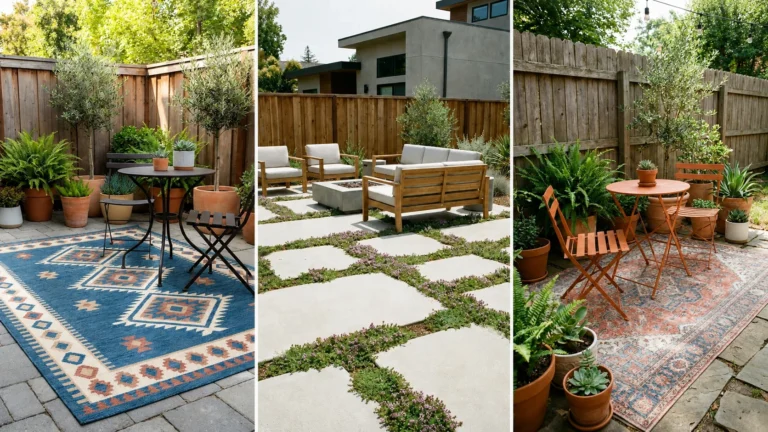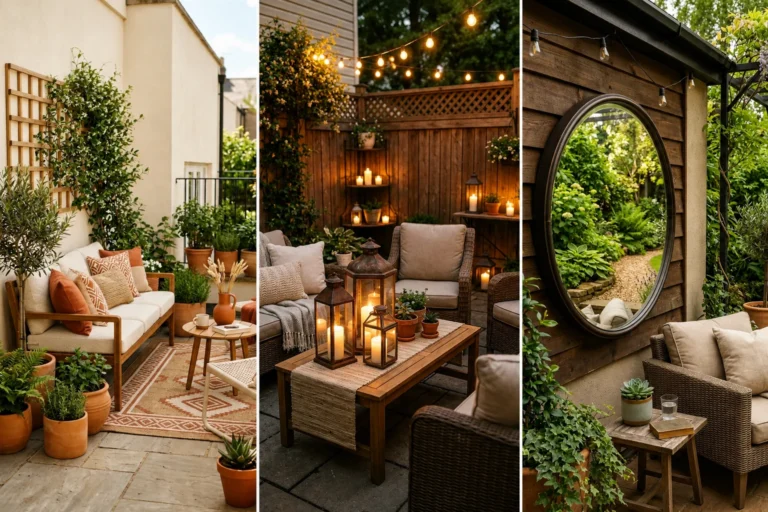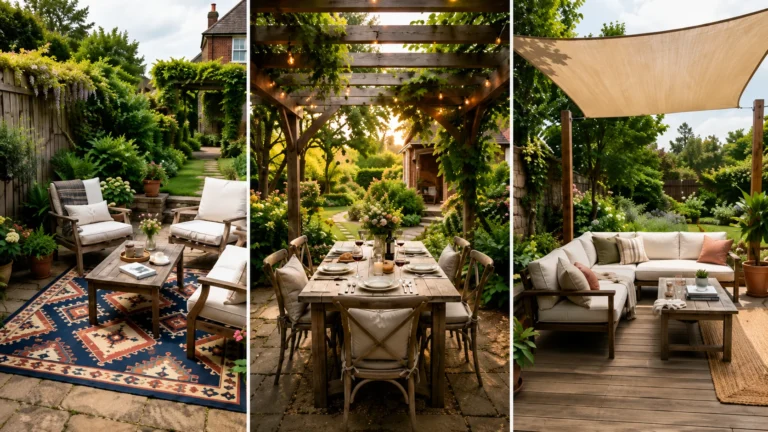
How to Hang Outdoor String Lights Without Drilling Into Your Building

Introduction
Drilling into the walls of a rented apartment, a listed building, or a surface you simply do not want to damage is not always an option — and it should not have to be. There are at least half a dozen reliable ways to hang outdoor string lights without a single drill hole, and most of them hold just as securely as a screwed-in hook when done correctly.
This guide covers every no-drill method available, from adhesive hooks to tension systems to freestanding poles — so you can find the right solution for your specific patio, balcony, or garden regardless of your surface type, your budget, or your landlord’s rules.
1. Outdoor Adhesive Hooks
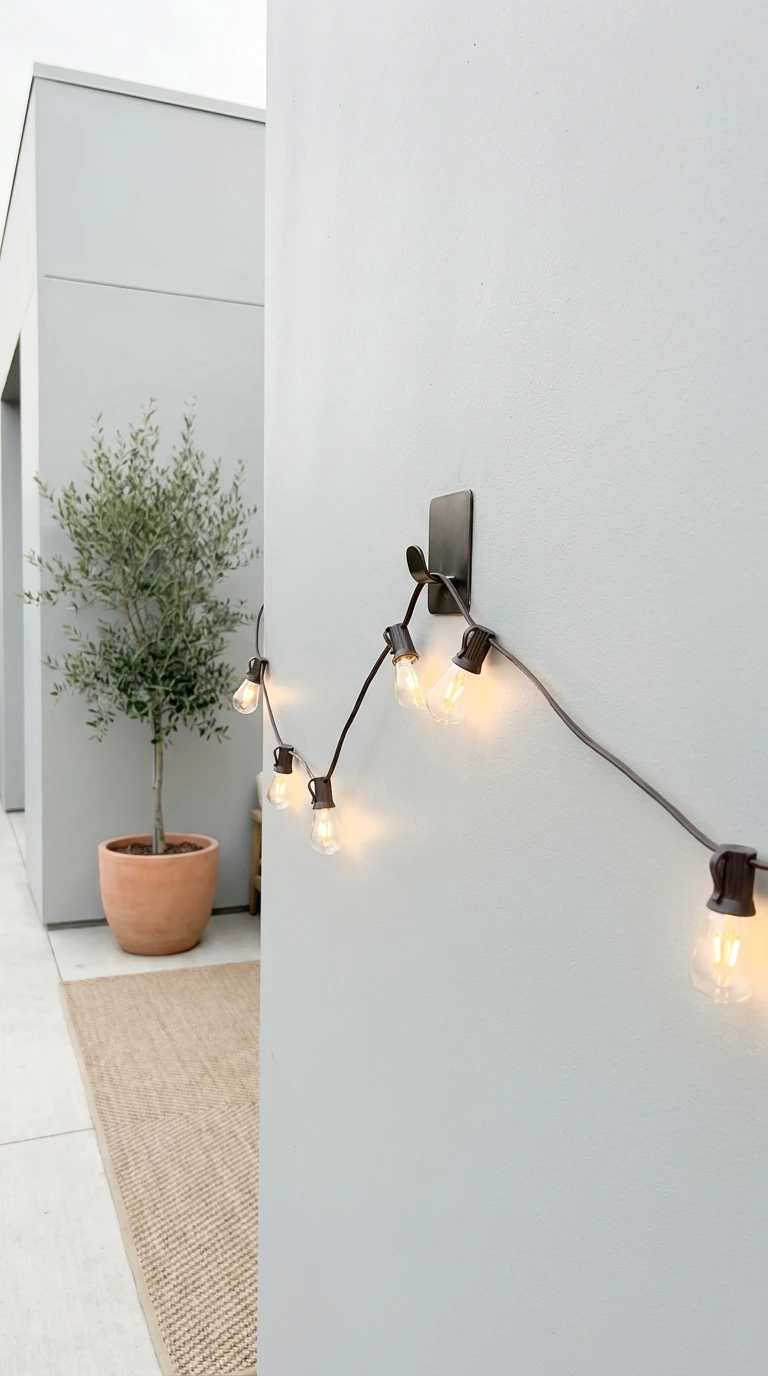
Outdoor-rated adhesive hooks — the most accessible no-drill solution available — hold surprisingly well on clean, smooth surfaces when applied correctly. The key word is outdoor-rated. Standard Command hooks are designed for interior use and will fail quickly when exposed to humidity, rain, and temperature fluctuations. Look specifically for hooks marketed for outdoor or weather-resistant use.
The weight rating matters. Most string lights are surprisingly light — a twenty-meter strand of Edison bulbs typically weighs under half a kilogram — but the hook needs to be rated for at least twice the weight you intend to hang, since outdoor conditions add stress that indoor testing does not account for. Apply to a clean, dry surface, press firmly for thirty seconds, and leave for twenty-four hours before hanging any weight.
Surfaces Where Adhesive Hooks Work Best
- Painted brick or rendered walls — smooth render works, rough brick does not
- Smooth exterior timber — fences, decking posts, wooden cladding
- Glazed tiles — outdoor kitchen backsplashes, tiled walls
- PVC fascia boards and guttering housings
- Metal surfaces — gates, metal fence panels, railings
Surfaces Where Adhesive Hooks Fail
- Rough or unpainted brick — the adhesive cannot bond to an irregular surface
- Textured render or pebbledash — same problem as rough brick
- Surfaces with existing paint that is peeling or flaking
- Surfaces that regularly get wet without drying — north-facing walls in wet climates
- Any surface that flexes or vibrates — thin timber panels, corrugated metal
Pro Tip: Clean the surface with rubbing alcohol before applying any adhesive hook outdoors. Outdoor surfaces carry invisible layers of pollution, dust, and moisture residue that dramatically reduce adhesive bond strength. A thirty-second wipe with rubbing alcohol and a thirty-minute dry time before application makes a measurable difference to how long the hook holds.
2. Tension Cable Systems
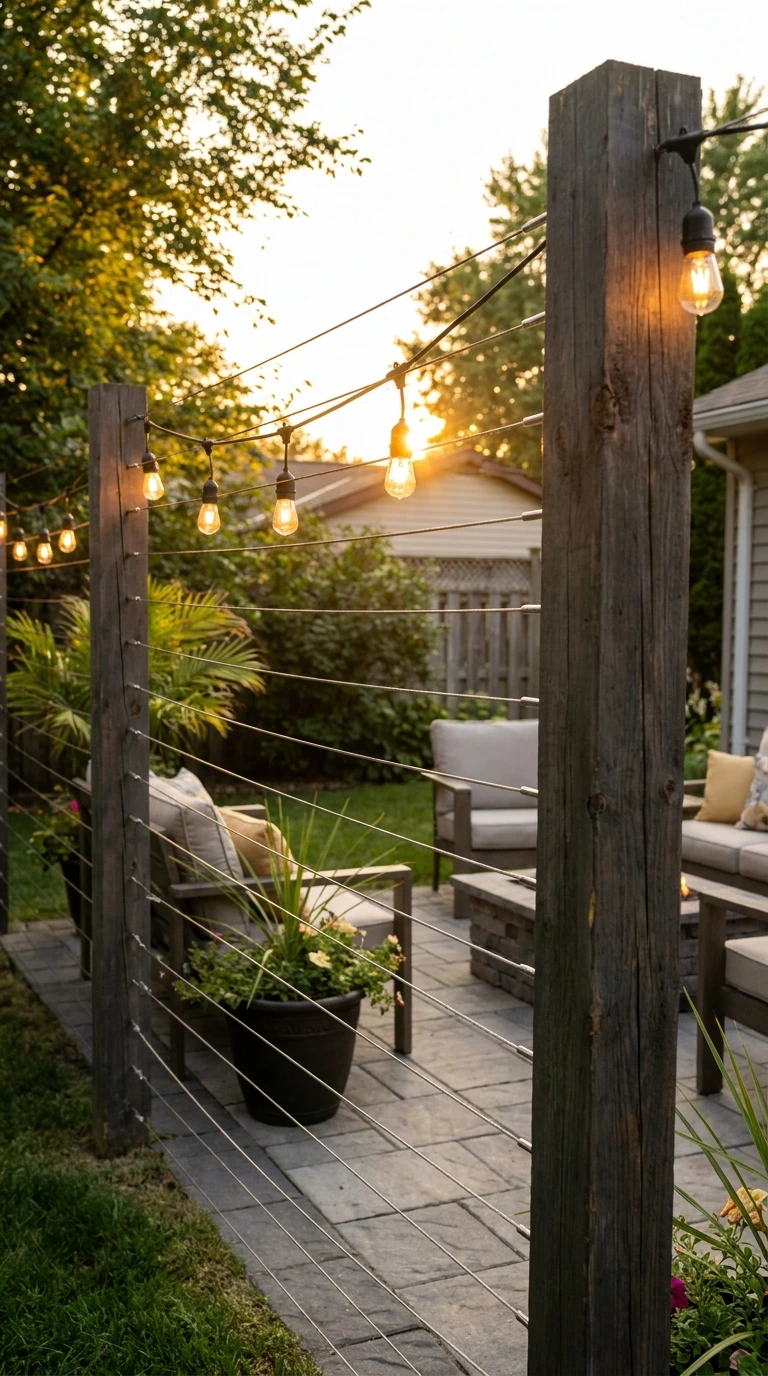
A tension cable — a length of wire or rope stretched between two anchor points and held taut by a tensioning mechanism — gives you a horizontal support line that requires anchor points at each end but no intermediate drilling along its length. This is the most elegant no-drill solution for longer string light runs across open spaces.
The anchor points themselves still need to be secured — but they can be secured using the adhesive hook method, the suction cup method, or by attaching to existing features like railings, fence posts, or shepherd’s hooks. The cable does the spanning work and the string lights hang from it rather than being attached to individual hooks spaced across the whole run.
How to set up a tension cable system:
- Choose a cable length that spans your intended run plus twenty percent for tensioning
- Secure one end to a fixed anchor point using a carabiner or hook
- Thread the cable through the string light cord at regular intervals
- Attach the opposite end and tension using a turnbuckle or tensioning clip
- Adjust tension until the cable runs level with minimal sag
Warning: Tension cable systems can exert significant lateral force on anchor points — far more than the weight of the lights alone suggests. A cable tensioned over a long span pulls the anchor points toward each other with considerable force. Make sure your anchor points — whether adhesive hooks, fence posts, or railings — are rated for this lateral load, not just the downward weight of the lights.
3. Shepherd’s Hooks and Garden Stakes
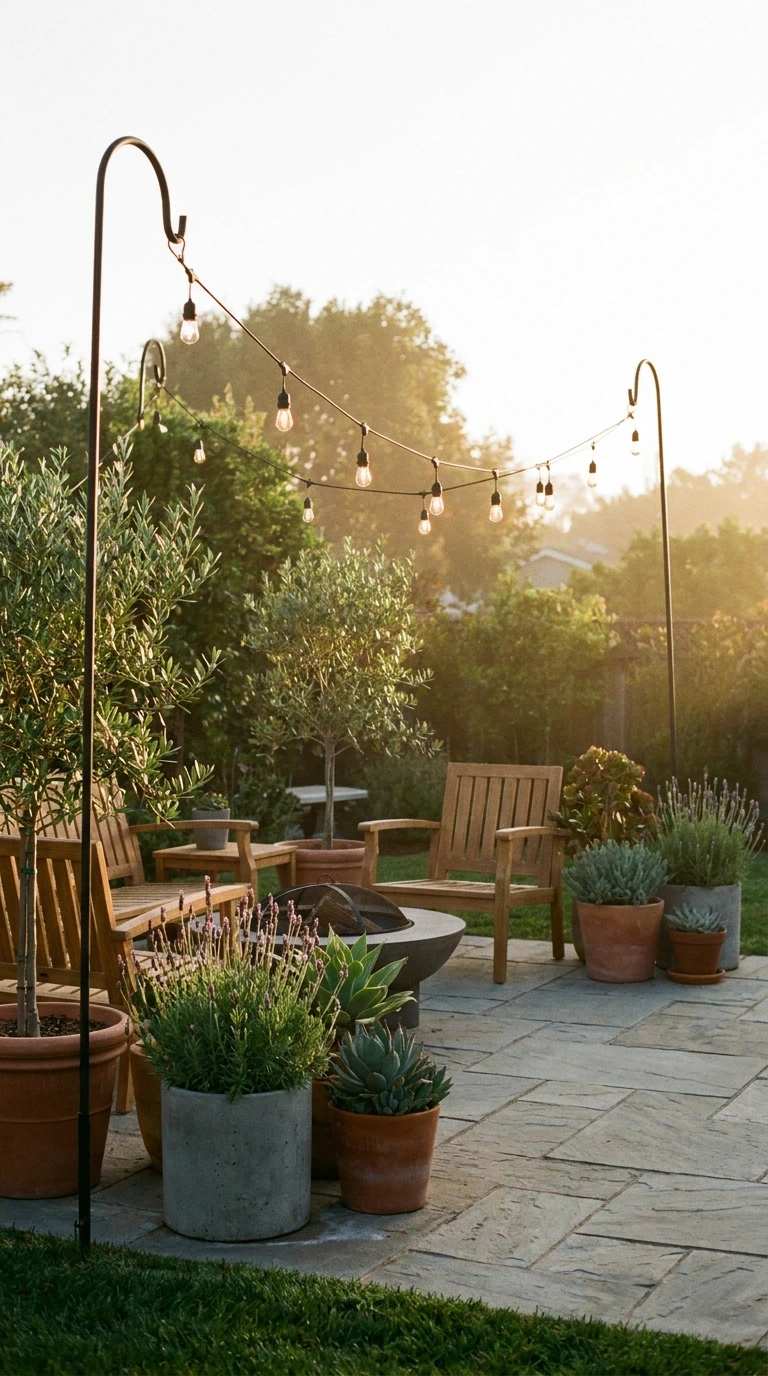
Shepherd’s hooks — the curved metal stakes sold for hanging bird feeders and garden lanterns — are one of the most versatile no-drill solutions available for patio string lights. They push directly into soil or lawn, require no surface attachment whatsoever, and can be repositioned anytime the layout needs to change.
A pair of shepherd’s hooks at opposite ends of a patio, with the string lights draped between the curved tops, creates an instant overhead span without drilling, adhesive, or any permanent installation. Taller shepherd’s hooks — available up to two and a half meters — create enough overhead clearance for a genuine canopy effect above seating areas.
Best uses for shepherd’s hooks:
- Creating anchor points in garden beds or lawn alongside a patio
- Adding mid-span support for long canopy runs
- Hanging lanterns and decorative lights at varying heights
- Creating light posts at the corners of a defined patio area
4. Freestanding Light Poles
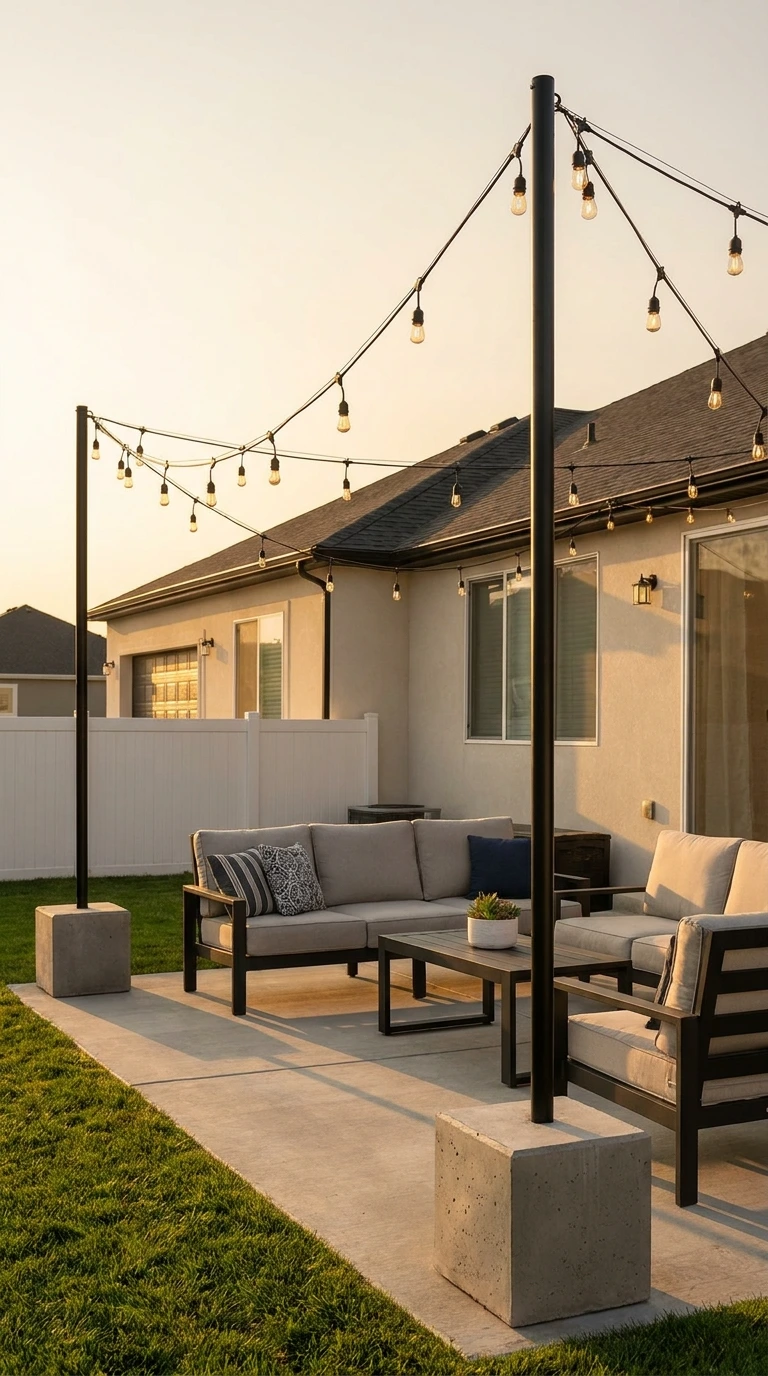
Purpose-built freestanding light poles — typically made from powder-coated steel or timber — stand independently on a weighted base and provide a dedicated anchor point for string lights anywhere in an outdoor space. No soil required, no walls needed. The weighted base holds the pole upright and allows repositioning whenever the layout changes.
The quality of the base matters enormously. A lightweight base will tip in any meaningful wind, bringing the lights down with it. Look for poles with a base weight of at least fifteen to twenty kilograms, or use a hollow base that can be filled with sand or water on-site to add weight. A pole with an inadequate base is more dangerous than no pole at all.
| Method | Best Surface | Max Span | Removable | Cost |
|---|---|---|---|---|
| Adhesive Hooks | Smooth painted walls | Short | Yes | Low |
| Tension Cable | Any with two anchor points | Long | Yes | Low-Mid |
| Shepherd’s Hooks | Soil or lawn | Medium | Yes | Low |
| Freestanding Poles | Any hard surface | Medium | Yes | Mid |
| Suction Cup Hooks | Glass or glazed tile | Short | Yes | Low |
5. Suction Cup Hooks
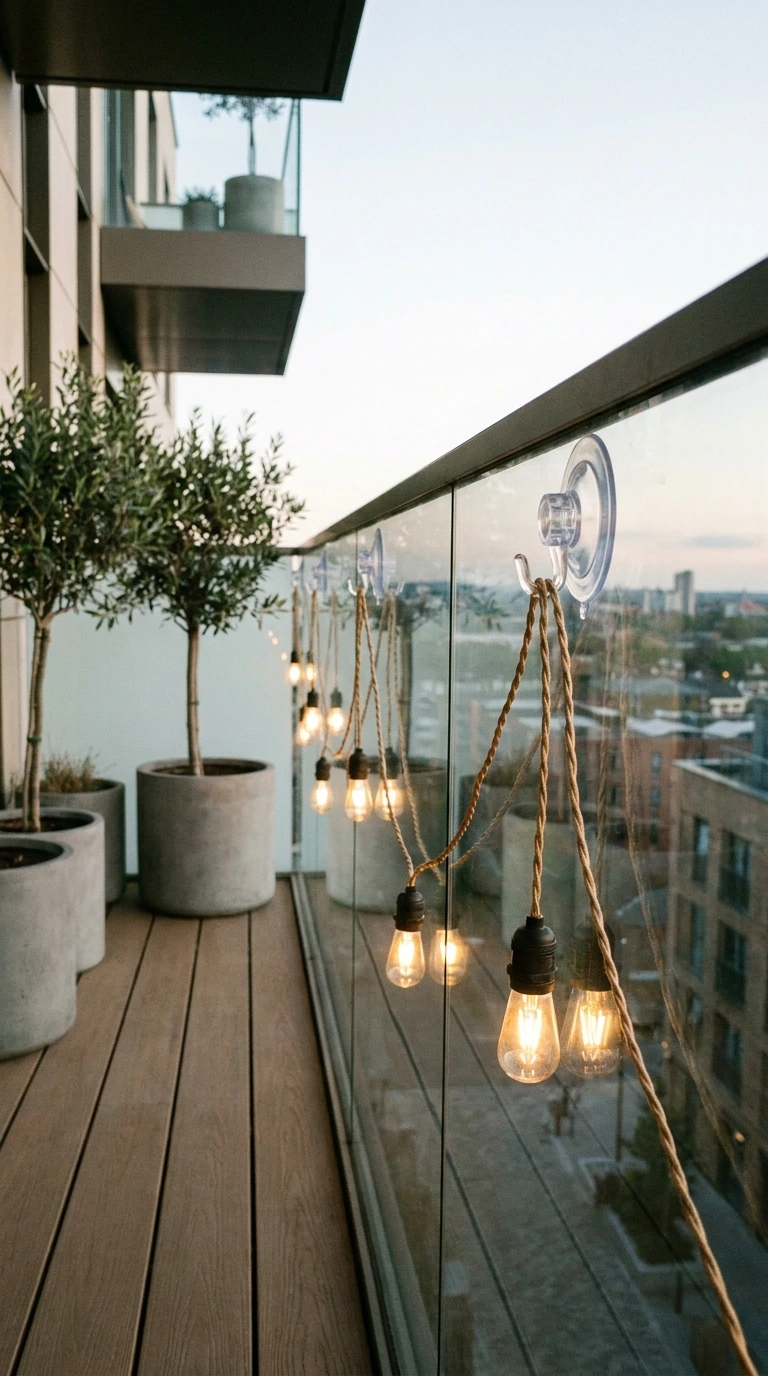
Heavy-duty suction cup hooks designed for outdoor use work on glass, glazed tiles, polished metal, and any other smooth, non-porous surface where adhesive hooks would either struggle to bond or leave residue when removed. A large outdoor suction cup with a hook can hold up to five kilograms on a suitable surface — more than enough for string lights.
The limitation is surface type. Suction cups require a completely smooth, non-porous surface to create a seal. They work on windows, glass balustrades, glazed outdoor tiles, polished stainless steel, and similar surfaces. They fail on any textured, porous, or rough surface. In the right application, they are one of the quickest and most residue-free attachment methods available.
Pro Tip: Suction cup hooks hold significantly better on cold surfaces than warm ones. In summer, the heat from direct sunlight softens the suction cup material and reduces the seal strength. Apply suction cups in the morning before the surface heats up, and check them periodically during the first few hot days to ensure the seal is holding.
6. Planter-Mounted Poles
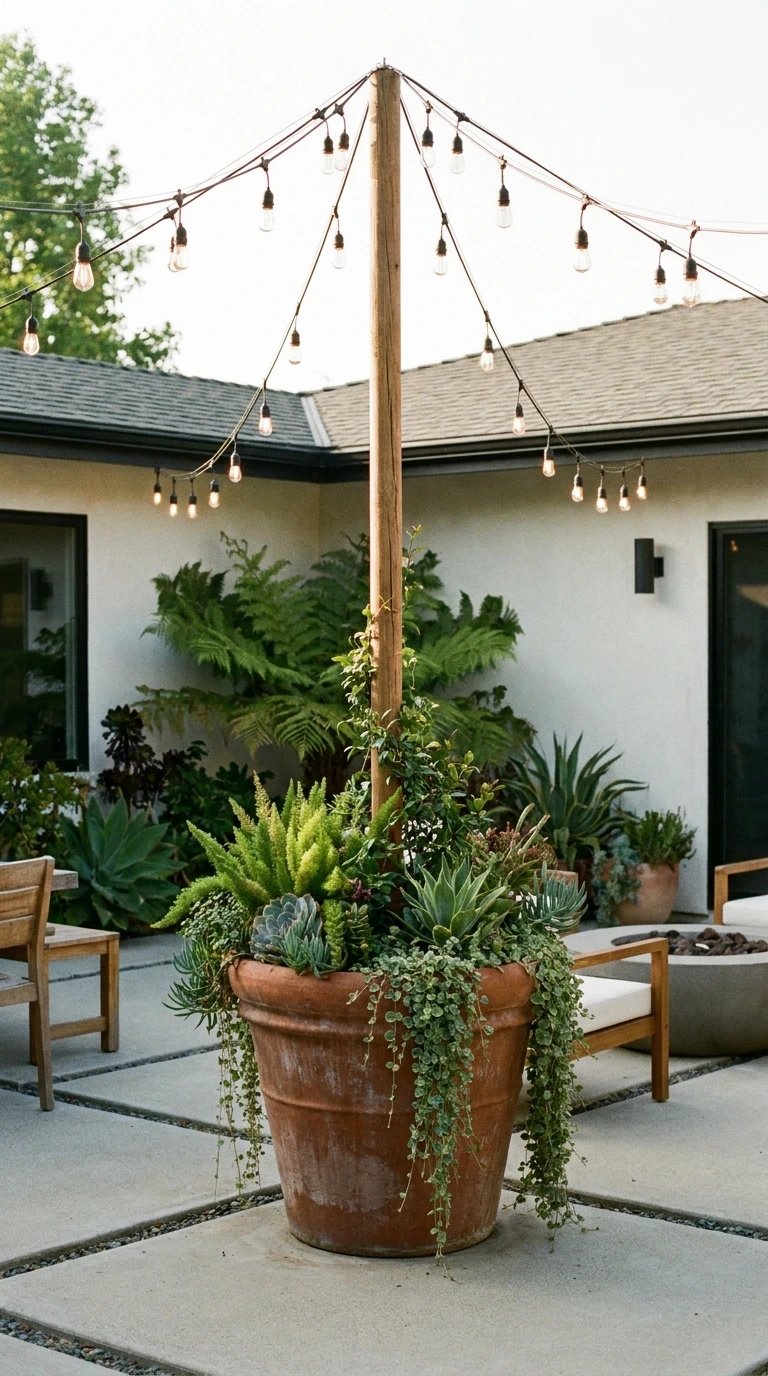
A heavy planter filled with soil or sand becomes a self-weighted anchor point for a timber or metal pole, creating a freestanding post anywhere on a hard-surface patio where shepherd’s hooks cannot be pushed into ground. A large terracotta or composite planter with a fence post or copper pipe set in the center provides a stable, attractive anchor point that doubles as a planting opportunity.
This is the most architectural no-drill solution on this list — a planter-mounted pole looks like a considered design decision rather than a workaround. Position one at each corner of the patio, run your string lights between the poles, and the result is indistinguishable from a permanently installed system.
How to build a planter-mounted pole:
- Choose a planter at least thirty centimeters deep and wide for stability
- Set a fence post, copper pipe, or timber dowel into the center of the planter
- Fill around it with concrete, heavy gravel, or compacted soil
- Allow concrete to cure for twenty-four hours before attaching lights
- Plant around the base of the pole to soften the look
7. Fence Post Attachments
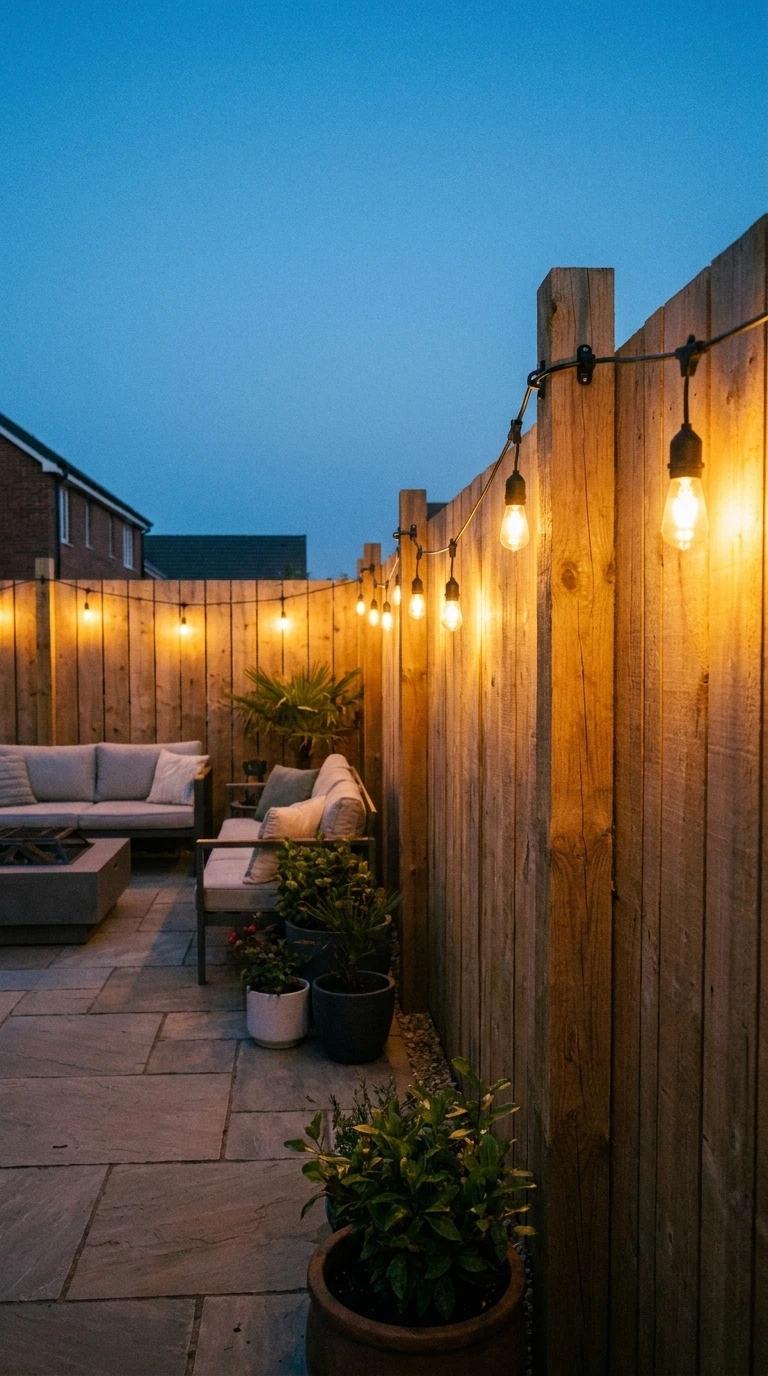
An existing fence — the most common boundary feature of any backyard patio — provides ready-made anchor points for string lights without requiring any drilling into building walls. Attaching lights to fence posts with outdoor-rated cable clips, zip ties, or purpose-made fence hooks creates a perimeter lighting setup that requires no adhesive and no screws into any structure you do not own.
Most fence posts can accept screw-in hooks or cable clips directly without any lasting damage to the fence — and in most rental situations, a fence post is considered a garden feature rather than part of the building structure, making minor attachments acceptable under most lease agreements. Always confirm with your landlord before attaching anything to a shared or boundary fence.
Important: Before using any no-drill attachment method, read your lease agreement carefully. Most agreements prohibit damage to the fabric of the building — walls, ceilings, and structural elements — but many are silent on garden features like fences and existing hooks. When in doubt, ask your landlord directly. A written confirmation of what is permitted is far more useful than an assumption.
8. Existing Architectural Features
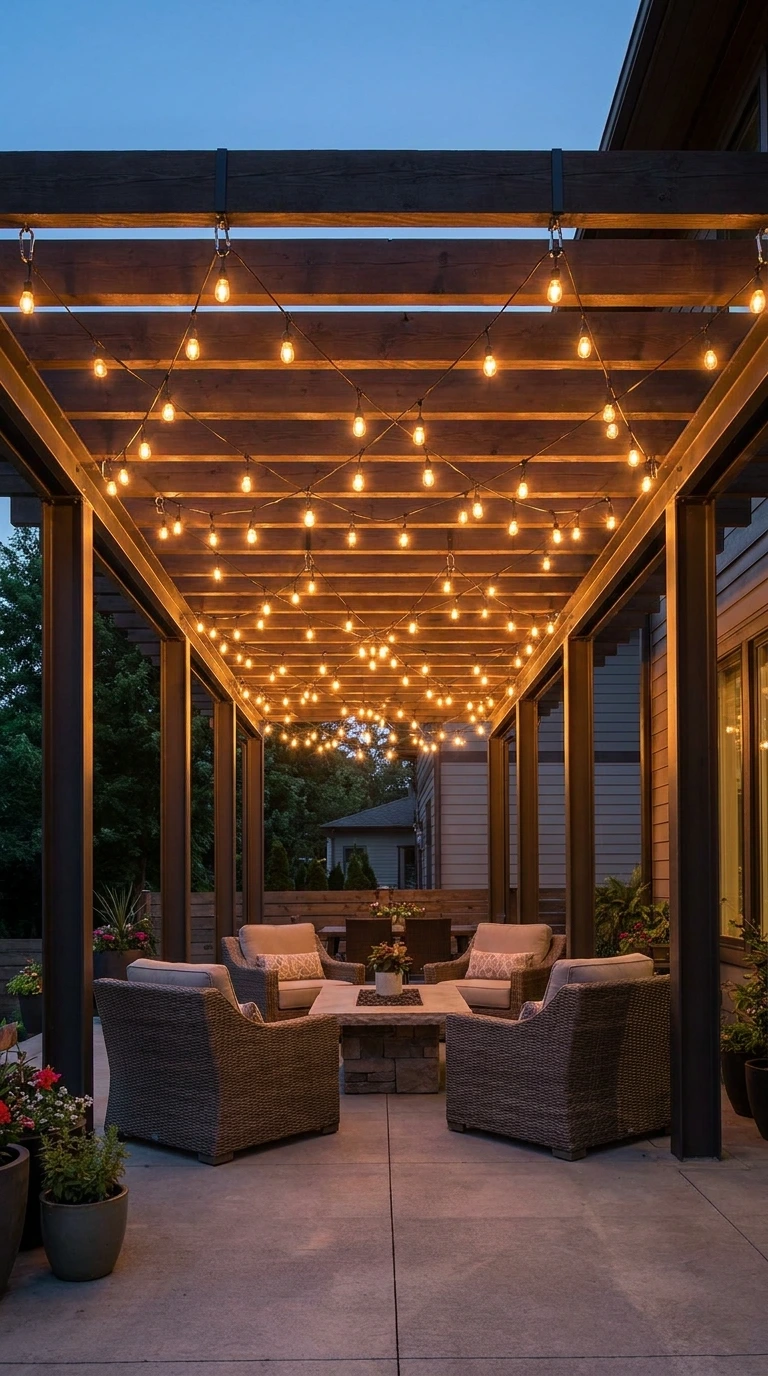
The most overlooked no-drill attachment points are the ones already present in most outdoor spaces — existing hooks, brackets, pergola beams, balcony railings, drain pipes, overhead cables, and any other feature that can accept a carabiner, a cable tie, or a simple loop of wire. A thorough survey of your outdoor space before purchasing any additional hardware often reveals more attachment points than expected.
Guttering brackets, security light mounts, satellite dish brackets, and even the fixings for outdoor power sockets all provide ready-made anchor points that accept a small carabiner or s-hook without any modification. Pergola beams and overhead joists are ideal for weaving string lights through or attaching at multiple points along their length. The hardware is already there — the string lights simply need to be connected to it.
Existing Features That Work as Anchor Points
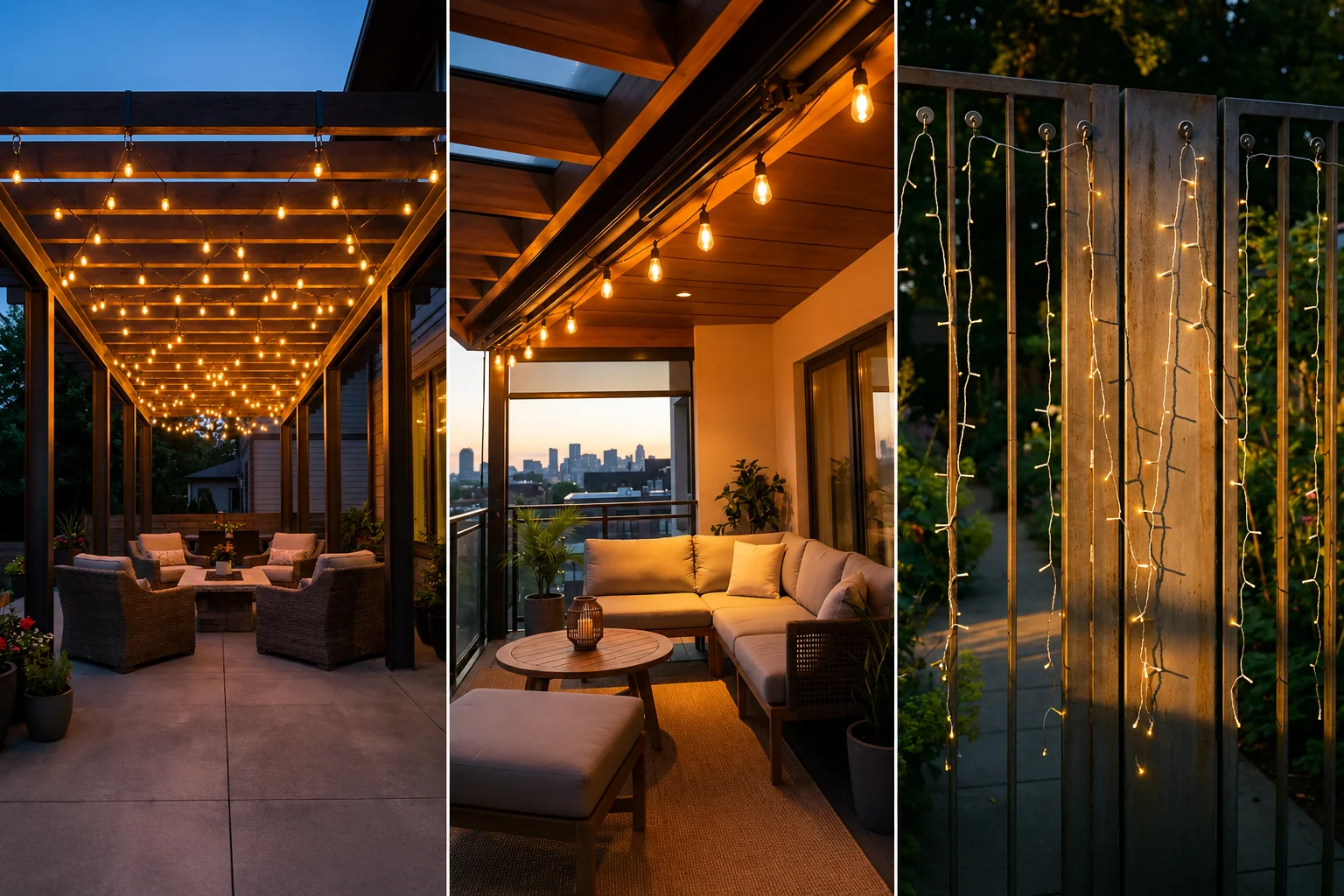
- Pergola beams and overhead joists — ideal for weaving or hooking
- Balcony railings — cable ties or s-hooks attach without damage
- Guttering and downpipe brackets — small carabiners fit most standard brackets
- Overhead cables and conduit — use cable ties rated for outdoor use
- Security light mounting brackets — most have an unused bolt hole or gap
9. Tension Rod Systems Between Walls
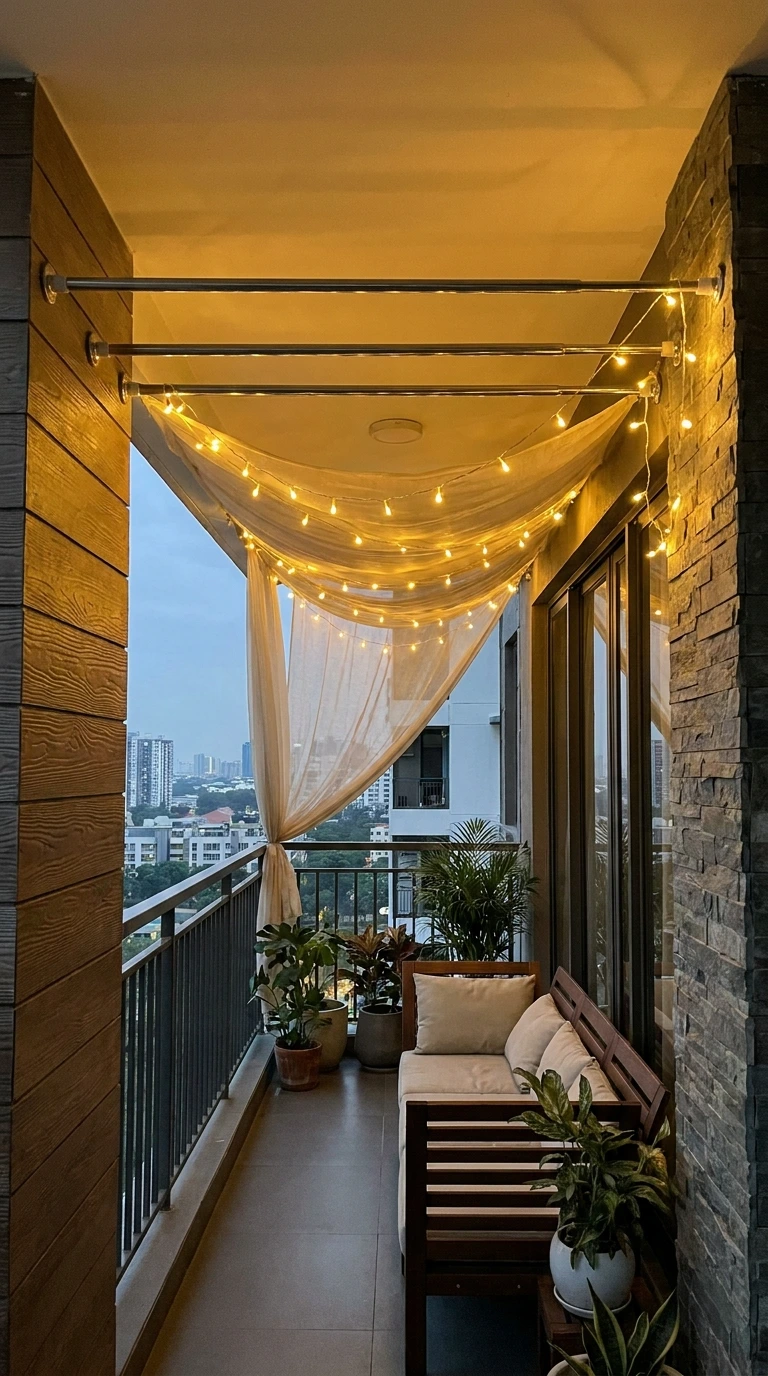
In covered outdoor spaces — a porch, a covered balcony, or a roofed patio area — tension rods mounted between two opposing walls at ceiling height provide a horizontal support rail for string lights without requiring any drilling. The rod is held in place by the outward pressure it exerts on the two walls, the same principle as a shower curtain rod.
Heavy-duty tension rods rated for outdoor use hold up to several kilograms per rod — enough for multiple strands of string lights draped across them. Space the rods every sixty to ninety centimeters for a dense canopy effect, or at each end of the run for a simple span. The rods leave no marks on the wall surfaces when removed.
10. Magnetic Hooks
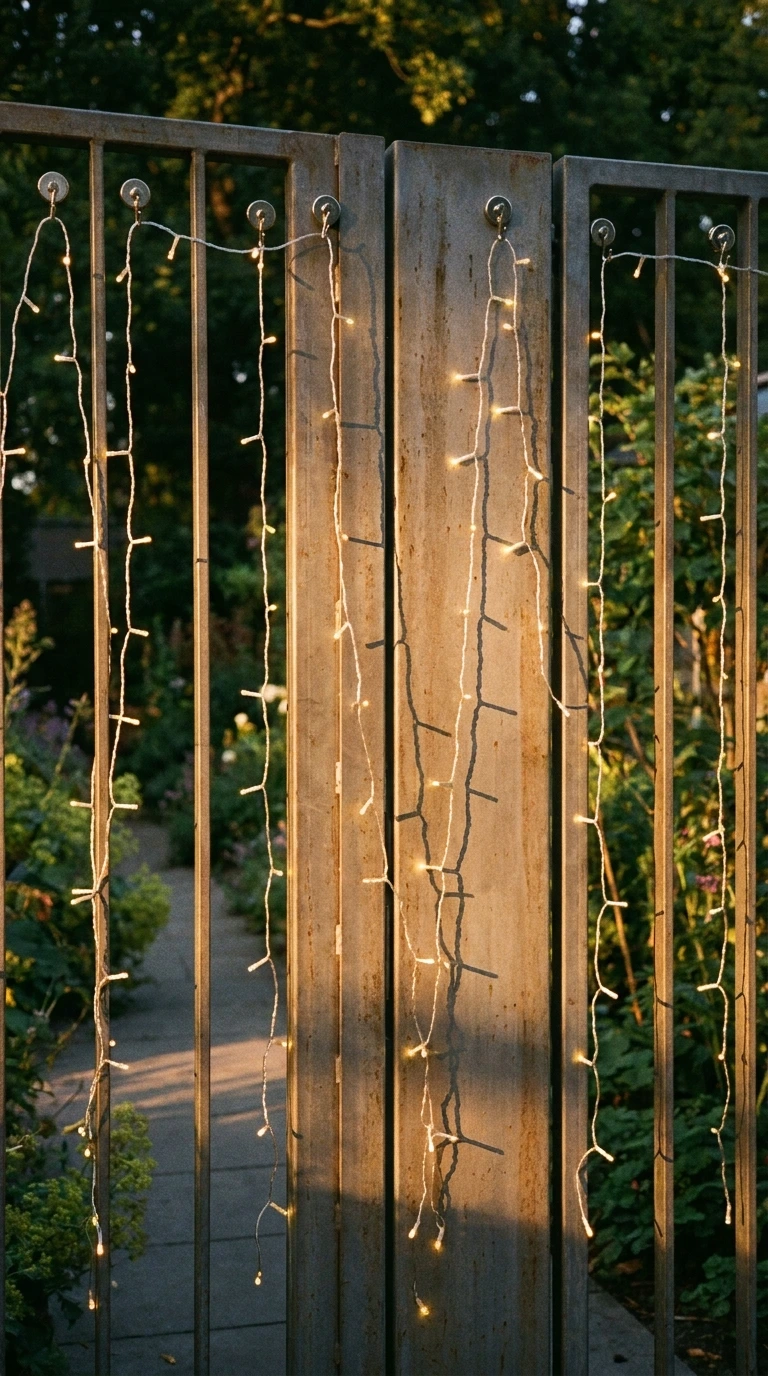
Magnetic hooks designed for outdoor use work on any ferrous metal surface — steel gates, metal fences, corrugated iron roofing, steel sheds, and metal-framed pergolas. They attach and detach in seconds, leave no marks, and can be repositioned without any tools. A strong neodymium magnet hook rated for five to ten kilograms handles string light loads comfortably.
Check the surface with a standard fridge magnet before purchasing magnetic hooks — if the magnet sticks, the hook will work. If the magnet does not stick, the surface is aluminium, stainless steel, or another non-ferrous metal and magnetic hooks will not hold. Powder-coated steel surfaces — the most common finish on outdoor metal structures — are almost always magnetic.
Warning: Magnetic hooks should never be used as the sole support for a string light run in windy conditions. The hook itself is secure on the metal surface, but the point where the string light cord loops over the hook becomes the weak point under lateral wind load. Use magnetic hooks as supplementary mid-span supports rather than primary anchor points in exposed, windy locations.
11. Guy Wire and Stake System
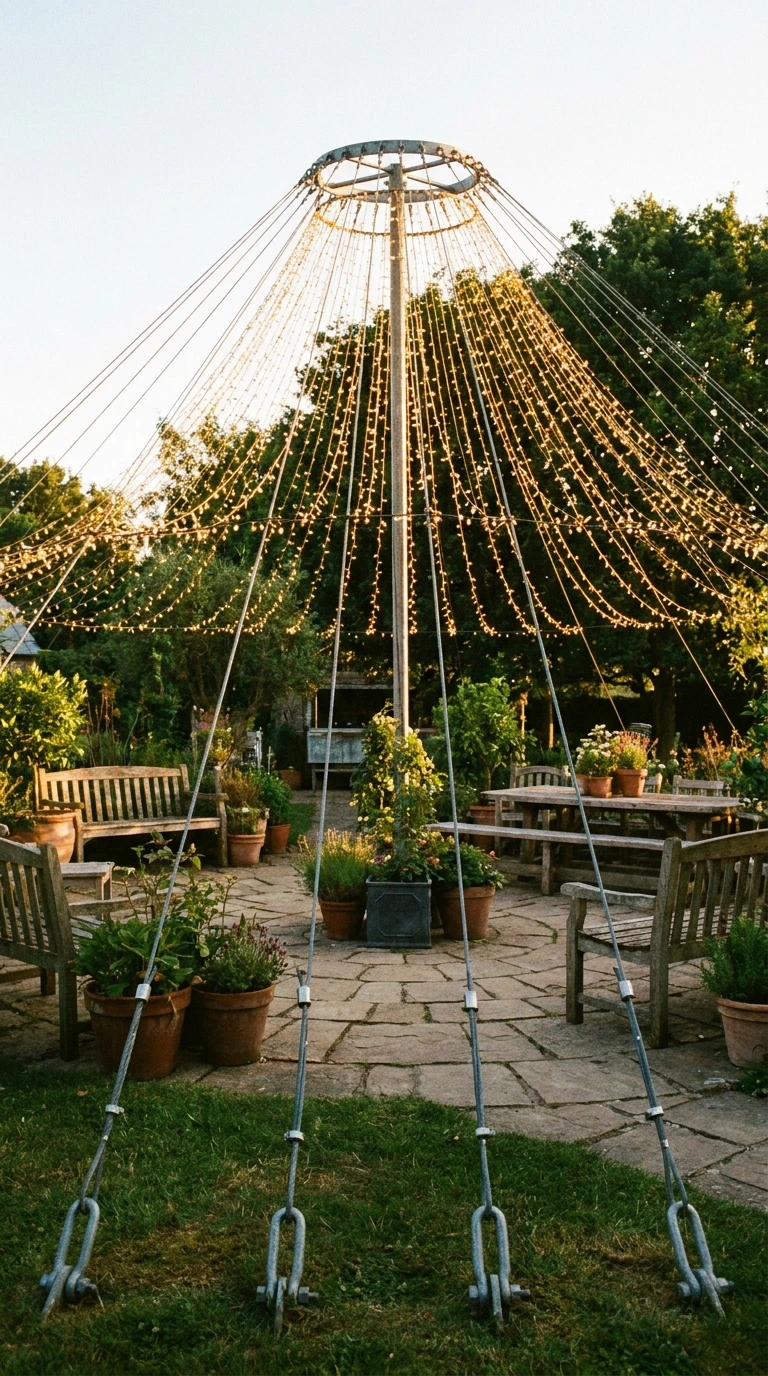
A guy wire system — cables staked into the ground at an angle and attached to a central point overhead — creates a tent-like structure of support lines that holds a central apex above the patio. This is the outdoor equivalent of a marquee structure and requires no wall attachment at all, making it ideal for open lawns or patios surrounded by garden beds rather than walls.
Drive a series of ground stakes around the perimeter of the patio, attach cables from each stake to a central high point — a tall central pole or an overhead hook — and hang string lights from the resulting web of support lines. This system handles high-wind conditions better than a simple horizontal canopy because the diagonal lines distribute wind load across multiple stake points.
12. Retractable Awning Track
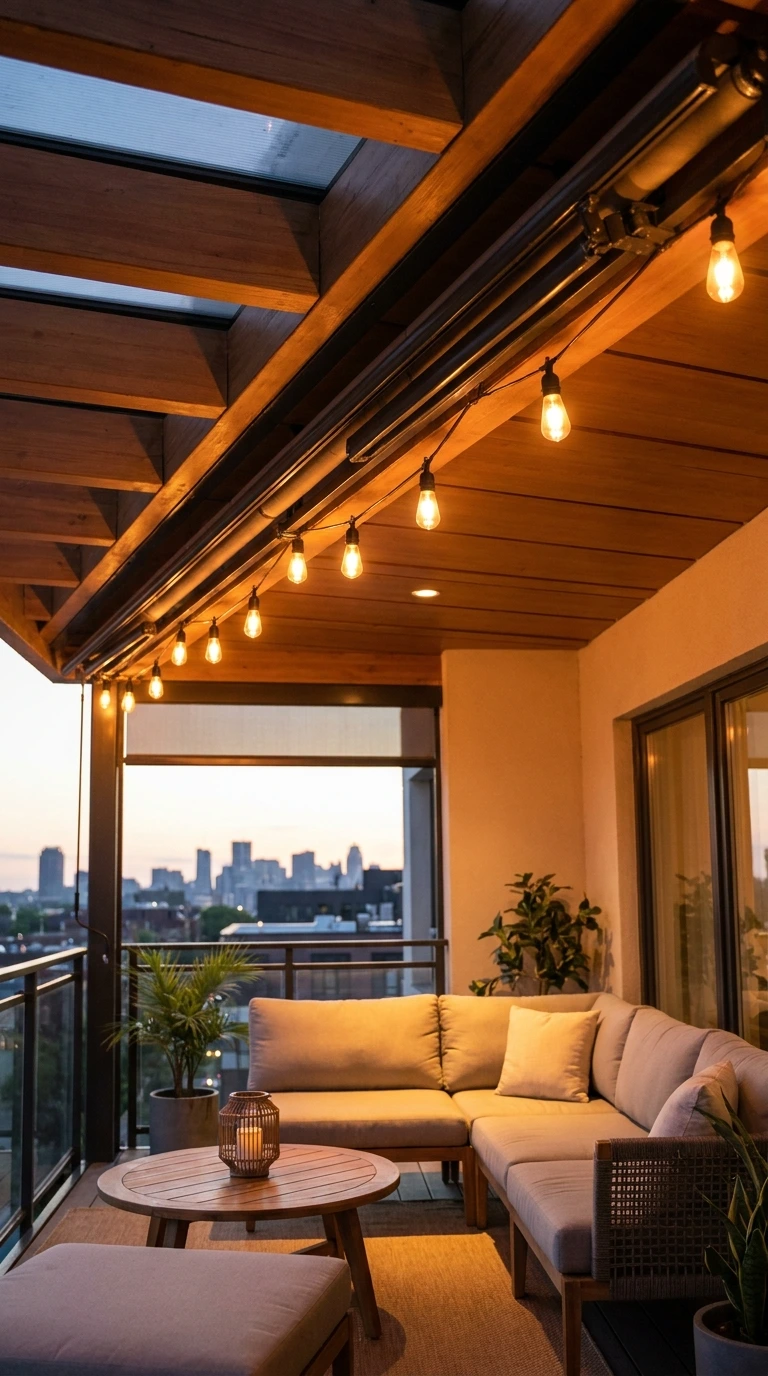
Many balconies and covered patios include a retractable awning with a track that runs along the ceiling or wall. The track itself — and the space between the awning mechanism and the ceiling — provides a ready-made channel for running string light cords and supporting individual hook points. No drilling required, no adhesive needed, and the track is already rated for far more weight than a set of string lights will ever impose.
Thread the string light cord through the awning track channel, attaching the lights to the track at intervals using small cable clips or zip ties. When the awning is retracted, the lights run neatly along the track. When the awning is extended, the lights create a layer of illumination between the awning surface and the ceiling above. This dual-use approach maximizes the value of an existing feature without any modification.
The No-Drill Method Comparison
Best for renters with smooth walls:
Outdoor adhesive hooks — highest surface compatibility on smooth painted or rendered walls, residue-free removal when used correctly.
Best for open garden patios:
Shepherd’s hooks or planter-mounted poles — no wall attachment required, infinitely repositionable, visually attractive when styled well.
Best for balconies:
Tension cable between railings, suction cups on glass panels, or magnetic hooks on metal railings — all three work without touching the building structure.
Best for covered patios and porches:
Tension rods between walls — quickest installation, no marks, handles multiple light strands across a generous span.
Best for long spans:
Tension cable system with adhesive or existing anchor points at each end — handles the longest runs with the least visible hardware.
Common Mistakes When Hanging Lights Without Drilling
Mistake 1: Using indoor adhesive hooks outdoors
Indoor Command hooks are not weatherproofed. They fail within days in outdoor conditions. Always use hooks specifically rated for outdoor use.
Mistake 2: Applying adhesive hooks to dirty or damp surfaces
The most common cause of adhesive hook failure. Clean with rubbing alcohol and allow to dry completely before applying. Do not apply during or immediately after rain.
Mistake 3: Underestimating wind load
A string light setup that holds perfectly in still conditions can fail dramatically in wind. The lateral force of wind on a long span of lights is far greater than the downward weight of the lights themselves. Account for wind in every attachment decision.
Mistake 4: Running extension cords across open ground
A cord running across a patio floor from the outlet to the lights is a trip hazard and an aesthetic problem. Plan the cord route along a fence line, under a rug, or along a wall before purchasing any hardware.
Mistake 5: Not testing before the event
Hanging lights the evening before a gathering and discovering they fall down mid-party is avoidable. Install at least forty-eight hours in advance and check all attachment points after the first wind event.
Frequently Asked Questions
Can Command hooks really hold string lights outdoors?
Outdoor-rated Command hooks can hold string lights on suitable surfaces when applied correctly to a clean, dry surface. Standard indoor Command hooks cannot. The distinction between indoor and outdoor-rated is significant — do not substitute one for the other.
How do I hang string lights on a brick wall without drilling?
Rough brick is one of the most difficult surfaces for no-drill solutions. Adhesive hooks will not bond reliably to rough brick. The best options are a planter-mounted pole positioned against the wall, a shepherd’s hook in an adjacent garden bed, or a freestanding light pole with a weighted base.
How much weight can adhesive hooks hold outdoors?
Outdoor-rated adhesive hooks typically hold between one and five kilograms depending on the brand, hook size, and surface quality. Most string light strands weigh well under one kilogram per ten meters — a standard twenty-meter Edison bulb strand weighs approximately three hundred to five hundred grams.
What is the best way to hang string lights on a balcony without drilling?
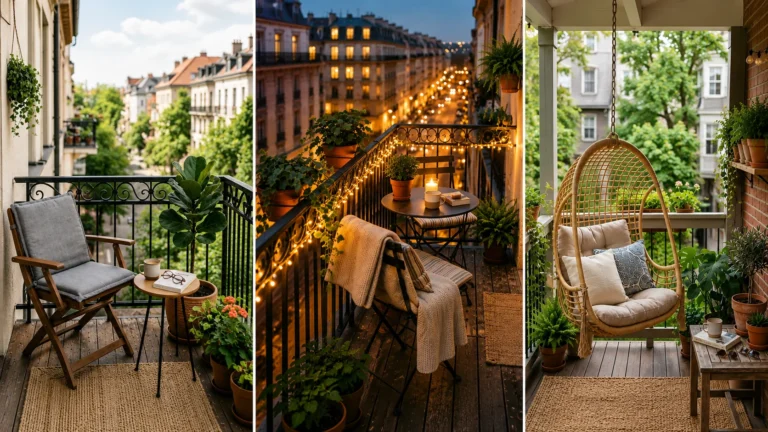
A tension cable between two railing points, magnetic hooks on metal railings, suction cups on glass panels, or adhesive hooks on smooth rendered walls all work well for balcony applications. The right choice depends on the specific materials of your balcony structure.
Will adhesive hooks damage my walls when removed?
Outdoor-rated adhesive hooks removed according to the manufacturer’s instructions — typically by pulling the adhesive tab slowly rather than pulling the hook outward — leave no marks on most painted surfaces. Pulling the hook outward rather than using the tab is the most common cause of paint damage on removal.
Can I use zip ties to attach string lights to railings?
Yes — outdoor-rated zip ties are one of the most reliable and inexpensive ways to attach string lights to railings, fence posts, and other structures. Use UV-resistant black or clear zip ties for the most invisible attachment. Cut flush with wire cutters after tightening for a clean finish.
How do I stop string lights from sagging in the middle of a long run?
Add a mid-span support — a shepherd’s hook, a tension cable, or an additional adhesive hook — at the midpoint of any run longer than three to four meters. The sag in a long unsupported span is caused by the combined weight of the lights pulling the cord downward. A single mid-span support point eliminates this almost entirely.
Conclusion
Not drilling into your building is not a compromise — in many cases, the no-drill solutions available are more flexible, more renter-friendly, and just as effective as anything you could achieve with a drill and a set of permanent fixings. The key is matching the right method to the right surface and accounting for wind load as well as the simple weight of the lights.
Start with a survey of your outdoor space and identify every existing feature that could serve as an anchor point. Add shepherd’s hooks or adhesive hooks for any gaps. Run a tension cable for any long spans. The result is a string light setup that looks permanent, holds securely, and comes down without a mark when you need it to.